THE SCIENTIFIC RESEARCH PROGRAM

Untouched Lophophora williamsii in the
regrowth study site population
Peyote post-harvest regrowth –
Summary of our observations in 2010.
PNF – Plant not found.
TNF – Tag not found.
nd – No data.
NP – Not present.
– – Missing
data.
Concerning data on regrowth involving multiple pups:
1) There is not necessarily a direct 1:1
correspondence between sequential figures for individual pups within a
single plant.
2) It was not uncommon for some or all pups to be
partly or entirely covered with soil so some photos may reflect the
pre-uncovery state.
Images of the tags can be viewed via the links for
the tag numbers and images of the actual plants can be viewed using the
links in the columns headed "Regrowth as number of pups".
The following 20 plants (#201-220) were harvested
during the November 2008 monitoring to make up for what was then
believed to be lost plants from the original group of 50 harvested
individuals. The March 2009 data presented below followed a severe
drought that lasted throughout the winter and into the spring, up
through the date of the March monitoring.
Late harvest adjunct group.
Plant No.
2009
2010
|
Regrowth as
number of pups
or
PNF/NP
|
Diameter of pups
(cm)
7 March 2009
6 March 2010
|
Comments
|
| |
201
201
|
0
2
|
nd
2.2, 1.2
|
|
202
202
|
0
2
|
nd
2.3, 2.1
|
Larger 3rd crown that was present is a sister to the
harvested plant. |
203
203
|
0
3
|
nd
2.5, 1.5, 1.5
|
|
204
204
|
0
2
|
nd
2.8, 1.9
|
|
205
205
|
0
0
|
nd
nd
|
|
206
206
|
1
1
|
2.0
1.8x1.0
|
See Note
following table.
Crown mostly eaten; fragmentary remains. |
207
207
|
0
2
|
nd
3.0, 2.0
|
|
208
208
|
PNF
NP
|
nd
nd
|
Evidently uprooted by
feral hogs.
Hogs |
209
209
|
0
2
|
nd
2.5, 1.6
|
|
210
210
|
0
1
|
nd
–
|
Plant mistakenly thought dead in 2009 causing missed
data. |
211
211
|
0
0
|
nd
nd
|
Sister of the harvested plant is still alive. |
212
212
|
0
0
|
nd
nd
|
|
213
213
|
0
nd
1
|
nd
nd
nd
|
Hog activity evident.
Updated data: 2010 July 26. |
214
214
|
0
4
|
nd
1.8, 1.5, 1.0. 0.5
|
|
215
215
|
0
1
|
nd
3.0
|
Unharvested twin also present. |
216
216
|
0
2
|
nd
1.1, 1.5
|
|
217
217
|
0
3
|
nd
1.5, 1.9, 1.0
|
|
218
218
|
0
0
|
nd
nd
|
Sister of the harvested plant is still alive. |
219
219
|
0
2
|
nd
2.5, 2.9
|
|
220
220
|
0
2
|
nd
3.0, 2.5
|
|
Note: In 2009 the sole post-harvest regrowth
pup (#206) in this drought-harvested adjunct group was regrowth from an
apical meristem, not from a subterranean areole. This apical meristem
regrowth was possible only because the crown was removed with a high
cut, slightly above ground level, so that the apical meristem remained
in the stem of the living plant rather than being removed with the
harvested crown.
The data summary for
the primary regrowth group.
The data summary
for the control group.
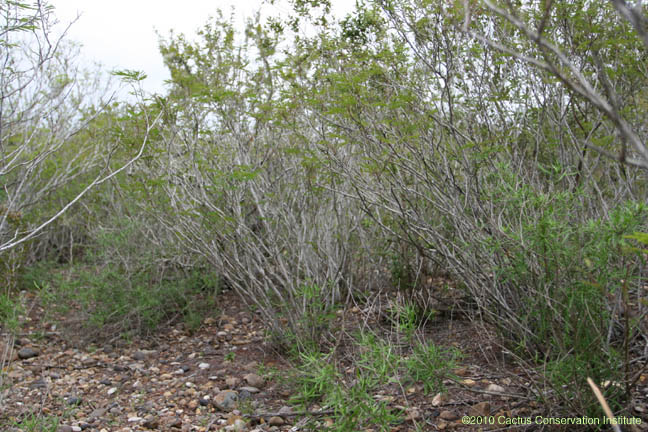
Regrowth study site showing typical Tamaulipan
thornscrub vegetation
If you would like to help
support additional studies of this type, designed to answer basic
questions that are critical to the optimal stewardship/management of
vulnerable cactus species, please send a contribution,
of $25 USD or whatever amount you can afford, to the Cactus
Conservation Institute, 909 E. Sul Ross Ave., Alpine, TX 79830.
We also now accept donations via PayPal.
|
|